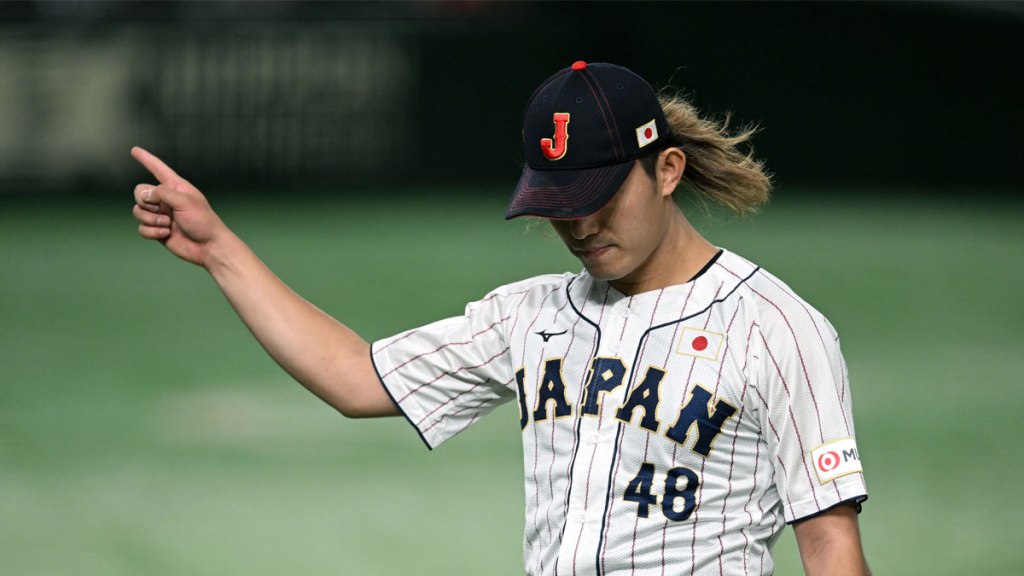
Last offseason one of the Orioles biggest signings was longtime Yomiuri Giants star Tomoyuki Sugano. Sugano’s career as an Oriole got off to a good start and honestly if you did a blame pie for the Orioles collapse in 2025 Sugano’s plate might be completely empty. He had a 3.38 ERA halfway through the season and by that time the Orioles were basically eliminated from the playoffs.
In fact in a lost season it was fun to root for Tommy Sugar as he tried to navigate his way through major league lineups with his kitchen sink approach. He made 30 starts, he was sweaty and cramped a lot and he even donned a Phiten necklace to fit in with the boys.
However the year didn’t end well for Sugano. In his last 15 starts he had nearly a 6 ERA to match a nearly 6 FIP and when you look at the overall numbers he was among the worst pitchers in the league in K%, Barrel rate and expected batting average. We’ll see if another team liked what they saw with Sugano but a reunion with the Orioles seems unlikely based on their current roster needs.
What is more interesting to me at this point is not whether the Orioles will reunite with Tomoyuki Sugano but rather the question, could that international signing be an indicator of things to come?
This offseason there are 2 Japanese stars that would be excellent fits on the Orioles so for today’s blog we’re going to look at the first of these players and how they could help the Orioles bounce back in 2026.
Tatsuya Imai
Yoshinobu Yamamoto’s incredible World Series performance has teams perhaps more excited than ever to tap into the Japanese starting pitching market. Anyone in the know will tell you that Tatsuya Imai is not Yoshinobu Yamamoto BUT he’s put up really impressive numbers over the last few seasons and he’s been a fun quote machine over the last few weeks
I want to talk about the quotes and the chances that he ends up in Baltimore but first let’s try to get an idea of who he is.
We’ll start with some basic counting stats. Here is how Imai’s stats over the last three seasons in NPB compare to some of the more prominent pitchers that have come over in the last 3 seasons.
As a reference I have also included the stats from each pitcher’s first season in MLB. So that you can get a feel for how some of those numbers translate.

These are very impressive numbers. You do have to take into account that Japan is in a pretty intense deadball era and offense is WAY down but even with that context they are very good numbers.
The number that jumps off the page in a bad way is the walks per 9 which is quite high and is something that Imai has struggled with in the past. When he was younger some people speculated that he would end up as a reliever if he came over to the States because the command issues were even more concerning at the time.
Over the past few years he has shown improvement in that area and in 2025 his BB/9 was all the way down to 2.5 which is fine.
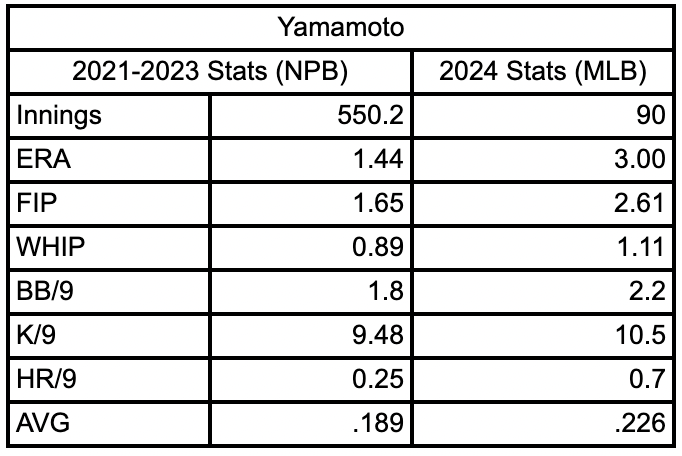
Looking at these stats you can see why people go out of their way to say “he’s not Yamamoto” when talking about Imai. These numbers are genuinely incredible, there’s a reason he was the first person to win back to back to back Sawamura Awards since the mid 1950s.
Yamamoto’s first year MLB numbers are a bit skewed because he dealt with injury but they were still pretty good and he was their best starter on a World Series team. Even though it’s not in the little chart I made, we also know what Yamamoto did in 2025 which was very impressive.
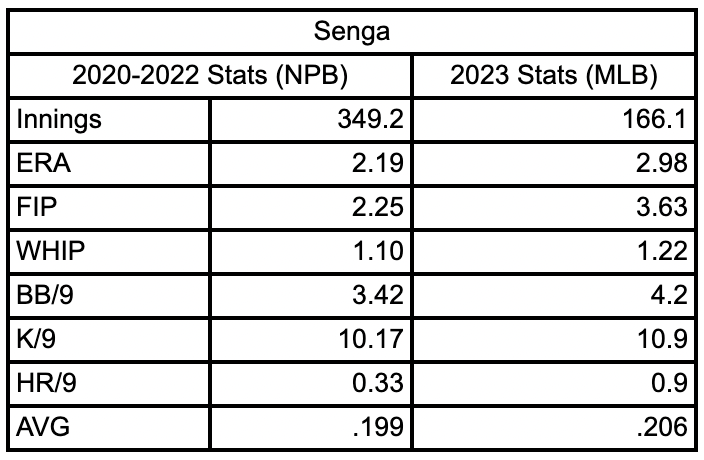
Senga is perhaps the best statistical comp for Imai. You can see over his last few seasons in NPB he was very good. They had nearly identical ERAs along with very similar FIPs, WHIPs and once again the real standout stat in the BB/9 which for both of them is uncomfortably high.
Senga being a close comp could be good or bad. Senga was very effective his rookie season despite having a BB/9 of 4.2. If Imai came over and in his first season was an All Star and finished top 7 in Cy Young voting that would feel like a smashing success.
But just a few short years later the Mets are making Senga “extremely available” this offseason in part due to his injury issues but also in part because the command issues have not improved and now that teams have seen him more his struggles with command might be reaching a tipping point where he won’t be nearly as effective going forward.
That being said the “bad” season Senga just had that made him extremely available resulted in a 3.02 ERA over 22 starts so it’s not like we’re talking about someone who has completely washed out to the league.
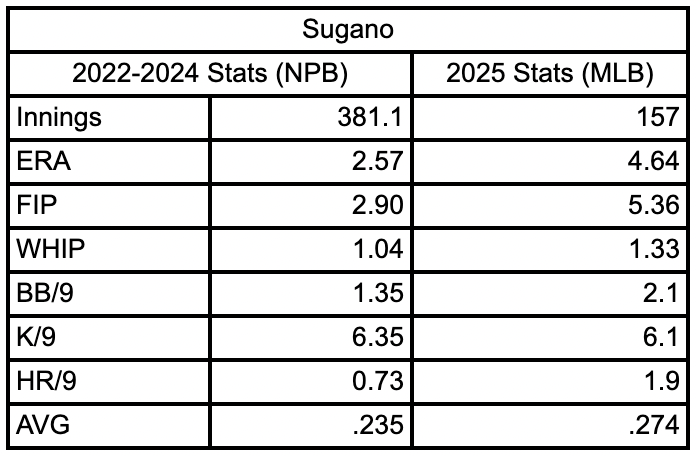
Sugano is a very different pitcher than Imai and he came over at a very different point in his career so it was almost a little silly putting him on here but I still think it is instructive to see how NPB stats correlate to MLB stats.
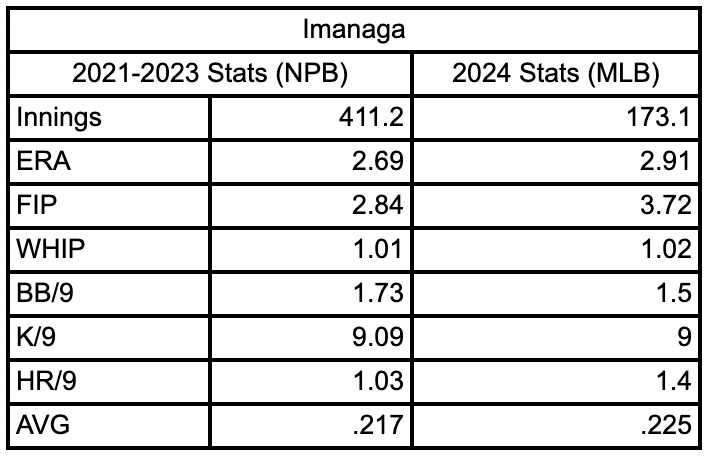
Out of everyone that has recently come over Imanaga came the closest to replicating his NPB stats in the States. However now that we’ve seen a second year from Shota it would appear the aging curve caught up with him rather quickly.
I’m not concerned with Imai having the same issues. He’s coming over much younger and his velocity is starting at a much better place in the mid nineties compared to Shota’s 90-91 mph heater.
As you look at the stats of these pitchers and how their NPB stats compare to their MLB stats you can see some trends. A serious math person would tell you that you can’t draw any real conclusions about a trend with a sample size of 4 but I’m going to do it anyway.
The ERA going up is an obvious one. If you go from the second best professional league to the best professional league in any sport you’re not going to be quite as good. As a group they averaged an ERA increase of 1.16. If Imai has that exact jump in ERA and goes from 2.19 to 3.35. Whatever team he ends up with would be very happy with that.
I think what is more interesting than that is the relationship between changing leagues and the K/9 and BB/9 numbers.
For the K/9 Yamamoto and Senga’s numbers both went up while Sugano and Imanaga’s numbers held pretty much at their NPB level. When it comes to the BB/9 numbers everyone except Imanaga saw a decent size jump in the amount of walks they were surrendering.
That makes sense as well because the hitters in the NPB are a lot more contact oriented vs the MLB where we see a lot more three true outcome baseball. That difference in approach results in more dramatic BB and K numbers.
We’re going to look into Imai’s stuff more in depth but if you were to just base your estimate on his counting stats it feels like a safe bet to predict he’ll end up with a mid 3s ERA, with about 10 K/9 and between 3.5 and 4 BB/9.
Imai’s Arsenal
I want to try to compare Imai to some non-Japanese starting pitchers. So let’s take a look at his arsenal and see who in Major League Baseball deploys a similar mix of pitches.
4 Seam Fastball
Avg Velo: 95 mph
Max Velo: 99 mph
Usage: 54% vs RHH – 43% vs LHH
We’ll start with the fastball which he throws a lot. Imai used his 4 seam fastball on over 50% of his pitches against righties and just over 40% of his pitches against lefties. His average velo on his favorite pitch sits around 95 mph but can get up to 98-99 mph.
That makes him just above league average in terms of average fastball velo and as far as recent Japanese free agents that puts him in very similar territory to Yamamoto and Senga.
Imai throws with an arm angle of about 20 degrees which is angle I would refer to as sidearm-ish. Comparable MLB pitchers include Aaron Nola, Charlie Morton and Logan Webb.
Charlie Morton is an interesting comp. After the season he had I’m sure nobody wants to hear that Imai bears any resemblance to Charlie Morton but in Charlie Morton’s prime his fastball was a good pitch and it’s defining trait was the armside run that it had. Cutting in on righties and tailing away from the lefties. Imai’s fastball is similar in that specific way. Besides the fastball Morton and Imai couldn’t be more different so this is the last time he’ll come up.
Here are some other comparisons that might be more appropriate. Below are some qualified right handed starting pitchers that throw their 4 seam fastball at least 45% of the time concentrated at the top of the zone at around 95 mph, just like Imai:
Bryan Woo
Luis Castillo
Cade Horton
Shane Smith
Emmett Sheehan
Spencer Strider
Ryan Pepiot
It’s a fun list of names. (There could be some survivorship bias because I filtered out non qualified pitchers so if a pitcher was throwing 95 mph 4 seamers 50% of the time and getting shelled to the point where he got DFA’d he wouldn’t show up)
Slider
Avg Velo: 86 mph
Max Velo: 90 mph
Usage: 39% vs RHH – 28% vs LHH
The slider is Imai’s put away pitch. It’s on this pitch that we see him get his highest whiff%, swinging strike% and chase%. It’s a really interesting slider because it’s actually a reverse slider. Typically a slider thrown by a right handed pitcher goes tails away from a right handed hitter but Imai’s slider dives in at the righties and away from the lefties.
This is a very unique pitch. If you just google reverse slider you’ll see a bunch of Trevor Bauer videos and several Pitching Ninja videos about Trey Yesavage. Upon further googling it seems like Luis Castillo also sometimes throws a similar reverse slider and I found a video from 2023 of Dauri Moneta flashing a reverse slider as well.
It’s interesting because if a righties slider is going the wrong way that makes it in some ways similar to a lefties slider and that kind of breaks the rules because typically it’s sliders are thrown to same handed hitters because to the opposite hand they sit in the bat path for longer and can run into more barrels. BUT a lefty could never imitate Imai’s armslot on the right side of the mound so it doesn’t seem to matter.
If you’re doing some quick math you’ll notice that the combined percentages between 4 seam fastball and slider are quite large. Against righties Imai is throwing the 4 seamer or the slider 93% of the time and it’s worked out really well for him. His last 2 seasons especially he has dominated right handed hitters with basically just those 2 pitches. Against lefties it’s a bit more balanced but it’s still 70% fastball/slider.
This is something that sets Imai apart from other Japanese pitchers who have come over recently. Most Japanese pitchers throw a lot of pitches and all of the major Japanese free agent pitchers in recent years have their splitter as one of their top 2 pitches by usage rate.
Imai does not, he’s a fastball slider guy. Which actually makes him a lot easier to compare to American pitchers.
Here are some of the more known (right handed) fastball slider guys who lean on those pitches the way Imai does:
Cade Horton (I’m considering the sweeper a slider) 71%
Emmet Sheehan 77%
Spencer Strider 86%
Joe Ryan 73%
Jacob DeGrom 84%
Hunter Greene 89%
Dylan Cease 82%
Logan Gilbert 71%
Justin Verlander 76%
Mitch Keller 70%
Luis Gil 77%
Max Scherzer 72%
Eury Perez 83%
Lucas Giolito 74%
This isn’t to say that Imai is going to be any one of these guys. In fact there are a lot of different kinds of guys in this group. There are guys who only throw 3 pitches like Hunter Greene and Luis Guil and there are guys who throw a bunch of pitches but just happen to lean on the 4 seam and slider the most like Joe Ryan and Eury Perez.
I think the most instructive part of these comps is when you are asking yourself “What will it look like when Imai is pitching in the big leagues?”, don’t picture Yamamoto or Senga throwing splitters, and cutters and curveballs. Instead picture a power fastball/slider approach with a changeup thrown in like what you might expect from a lot of American/ Dominican pitchers even if the slider is going the wrong way.
Changeup
Avg Velo: 85 mph
Max Velo: 89 mph
Usage: 4% vs RHH – 16% vs LHH
Vulcan Changeup
Avg Velo: 81 mph
Max Velo: 86 mph
Usage: 1% vs RHH – 4% vs LHH
Imai throws two variations of the changeup. One is a standard changeup that is his third most popular offering to left handed hitters. The other is a vulcan changeup which is when a pitcher throws a changeup by using a modified splitter grip. (It’s a grip that only a handful of MLB pitchers use and on statcast I can’t see that they differentiate for the few that do).
The main purpose of the changeup is to give him another option against lefties. He throws it low and outside with the goal of getting lefties to chase and whiff. It’s pretty rare you’ll see the changeup land in the zone.
Splitter
Avg Velo: 85 mph
Max Velo: 90 mph
Usage: 1% vs RHH – 7% vs LHH
Imai added the splitter in 2024 and ramped up his usage of it in 2025. Similar to the changeup it is primarily deployed against lefties. My main takeaway from looking at the splitter increase in splitter usage is that it demonstrates Imai’s efforts to improve against left handed hitters which was an area that he “struggled with” compared to right handed hitters.
So righties get a strong diet of fastball slider which has always worked for Imai and if it ain’t broke don’t fix it. Lefties on the other hand get much more of a kitchen sink approach where they might see either of his changeups or the splitter and now they have to worry about up to 99 at the top of the zone AND potentially 5 different offspeed pitches. It just makes the at bat that much harder.
Curve
Avg Velo: 78 mph
Max Velo: 80 mph
Usage: 2% vs RHH – 2% vs LHH
This is a pitch that Imai has thrown less and less over the years and now he hardly ever throws but maybe he should do it a little more. You’d be surprised but a bunch of the best pitchers in the league throw really slow curveballs every now and then. Yamamoto throws a 76 mph curve all the time and Freddy Peralta features a 78 mph curve.
On the other hand it’s possible this pitch doesn’t travel with Imai overseas.
Comps
So now we know what Imai throws and how often he throws it but what does that tell us about who he’ll be when he comes over from Japan.
This may be odd to say when describing someone who has never pitched in MLB before but to my eye Imai has a really high floor. The velo on the fastball should play in MLB and the reverse slider/ gyroball whatever you want to call it will continue to confound hitters.
When it comes to comps it’s very tricky.
I won’t give a floor comp because the floor is that he comes over and the fastball is incredibly hittable and he can’t throw his secondaries in the strike zone and before we know it we get the Passan notification that Imai drove over a pothole and will be out for a few weeks.
But on the lower end of reasonable outcomes I think you could expect something like Luis Ortiz. Not because I think he’s going to get arrested for pitch fixing but because Ortiz is sidearmy fastball/slider guy (at very similar velocities) who struggles with command.
If you look at Ortiz’s career in the years he struggled with command he’s a mid 4 ERA guy who would be worth about 1 WAR over the course of a full season. The one year he was able to keep it in the zone he was suddenly a low 3 ERA guy worth over 3 WAR.
I think with Imai it could be a similar story. If he falls back to his old command problems he will be much less effective, probably topping out as a mid to back of the rotation, 5 and dive kind of guy and that’s fine but not a gamechanger.
On the other hand if he can continue his trend of improving his command I think he could be a top of the rotation arm and the pitcher I’d compare the best version of Imai to would be 2023 Luis Castillo.
Castillo has a more exaggerated sidearm motion than Imai but the effect on the ball is similar. They both throw mid to high nineties and their fastball gets a lot of arm side run which makes it tricky for hitters to square up. Castillo’s primary secondary is also the slider just like Imai (although to my eye Imai’s reverse slider is much more “reverse” but the point is that it’s a slider that people swing and miss at) which only makes the comparison more compelling.
I don’t know if it’s fair to expect him to hit the 197 inning mark in his first MLB season like Castillo did in 2023 but the 3.34 ERA, 3.81 FIP, 10 K/9 and 2.6 BB/9 seems I think are fair expectations when it comes to Imai’s ceiling. That pitcher would be a real difference maker for a contending team.
Based on those comps I’d say this is a risk worth taking and based on the projections for the contract that Imai will sign this offseason most teams are on the same page.
So could the O’s land Imai?
When it comes to signing Japanese and Korean free agents the teams on the west coast are thought to have an advantage over the rest of the league for simple geography reasons. However in recent years plenty of Japanese stars have landed on the east coast. Senga to the Mets, Yoshida to the Red Sox and although it’s not on either coast Chicago signed Suzuki and Imanaga in the last few years.
So the O’s aren’t out based on geography at least.
Now let’s get into some of the quotes.
“They’d just tell you anything if you asked, right? I don’t really want that. In a way, I want to experience that survival vibe, you know, and when facing cultural differences, making how I overcome them on my own one of the fun parts.”
I want to start with this one because I think it is the less meaningful of his recent viral quotes. It’s easy to look at this and think ok well that rules out any team that has a Japanese player under contract but I don’t think if the Padres offered him the most money he’d say “No I don’t want to be on the same team as Yu Darvish”.
Cynically when I read this I thought of when Roki Sasaki’s agent was quoted saying that Sasaki might want to play for a small market team before signing with the Dodgers. So it reads to me as a possible leverage play where he’s basically saying “I want every team in the league to feel like they could sign me and I want the teams with Japanese players to feel like they might have to pay more because that will only drive the price up.”
That’s not necessarily the case, not every quote is that strategic.
For the Orioles though the quote is still nice to hear because if he had said the opposite like “I want to play on a team with other Japanese players that would have ruled out the O’s. So the O’s aren’t out based on the players currently on the roster.
Here’s the next quote
“I want to take them (The Dodgers) down…I think beating a team like that and becoming world champions would be the most valuable thing in my life.”
This one is the one that got people really fired up. Because the Dodgers have successfully wooed the last 2 big Japanese stars to come over when it was announced there would be another great Japanese pitcher coming over it felt like he would likely sign there but instead he’s gone out of his way to make it clear he wants to go against them.
For the Orioles though this quote is potentially a problem. You could see a version of them reaching out to him and Imai saying “You won 75 games last year and you think me and Taylor Ward are going to be the difference between 4th place in the AL East and defeating the Dodgers in the World Series?” (Probably not in those exact words)
But if he gave them a shot to make their case I do think there is a case to be made. They could tell him the about how the won the most games in the AL from 2023 to 2024 (I’m going to make it a goal to never bring this up again) they could show him Bradish’s stats from his last healthy season and Rogers’ stats from last year and say this is the rotation you’d be joining and they could show him a Gunnar Henderson highlight reel. All could be very compelling.
Unfortunately if his main goal is to compete against the Dodgers the Padres and Giants are both good teams that want to compete with the Dodgers. Their message on “taking down the Dodgers” would be more direct. If the O’s want to take down the Dodgers they’d have to win the World Series, on the Giants he could take down the Dodgers by helping San Francisco win the Division or beating them in the NLDS both much more likely than the Orioles winning the World Series.
Even if he wanted to join an American League team the Yankees, Blue Jays, Mariners and the Red Sox are currently better positioned to “take down the Dodgers” than the Orioles. So if that’s what this is all about then the O’s are at a disadvantage.
Fortunately what free agency is really all about is money. The Orioles are a good enough team that if they were willing to win the bidding war for Imai I believe he would sign with Baltimore.
So the question is are the Orioles willing to win the bidding war for Imai?
It would feel out of character based on how they’ve operated under Mike Elias. However no matter how much ownership professes to believe in Elias if he has another dud offseason like last year then I don’t see how he keeps his job.
Elias has given multiple quotes about how aggressive the Orioles are going to be this offseason and that they have no financial constraints. As free agents and trade targets come off the board Imai seems more like a possibility. If only because coming home empty handed is not an option for this front office and they have 70 million dollars to spend before they get back to last years payroll.
So the O’s have the means, they have the need and their front office is under pressure, why wouldn’t this happen?
One of my continuing criticisms of this front office is that they are obsessed with “value” and unless Imai is a perennial Cy Young candidate, the amount of money they’d have to pay to win the bidding war over motivated teams like the Giants and the Mets will make it almost impossible for the contract to come out in the positive valuewise when it is all said and done.
So I expect Imai to go to one of those teams that is willing to lose value on the overall contract to improve their chances of contending now and that’s just not the O’s. Maybe they’ll surprise me though.
 The Dishwasher
Leave a comment